



Trk
Trk receptors are neurotrophin receptor tyrosine kinases that mediate neurotrophin-dependent neuronal survival, differentiation, development, and broader physiological effects[1][2]. Mechanistically, activated Trk receptors signal through phosphotyrosine-mediated pathways, including Shc, PLCγ, PI3K, Ras/MAPK, and Akt, thereby linking ligand binding to transcriptional and survival responses[1][3][4]. In experimental models, NGF-activated TrkA forms internalized signaling vesicles that may support retrograde neurotrophin signaling in neurons[5]. In disease models, Trk signaling contributes to cancer biology: TrkA is overexpressed in oesophageal squamous cell carcinoma, p-TrkA is proposed as a potential epithelial ovarian cancer marker, and Trk inhibition reduces lymphoma cell survival or proliferation[6][7][8]. Compared with related isoforms, TrkA primarily mediates NGF responses, TrkB responds strongly to BDNF and also NT-3, whereas TrkC functions as a high-affinity NT-3 receptor that does not bind NGF or BDNF[9][10]. This isoform distinction supports research designs that select ligands, receptor readouts, and inhibitors according to TrkA, TrkB, or TrkC biology rather than treating Trk as a single target class[9][10].
References:
- [1]. Parada LF, et al. The Trk family of tyrosine kinases: receptors for NGF-related neurotrophins. Cold Spring Harb Symp Quant Biol. 1992;57:43-51. [Content Brief]
- [2]. Tessarollo L, et al. trkC, a receptor for neurotrophin-3, is widely expressed in the developing nervous system and in non-neuronal tissues. Development. 1993;118(2):463-75.
- [3]. Gunn-Moore FJ, et al. Analysis of mitogen-activated protein kinase activation by naturally occurring splice variants of TrkC, the receptor for neurotrophin-3. Biochem J. 1997 Feb 15;322 ( Pt 1)(Pt 1):193-8. [Content Brief]
- [4]. Yang Y, et al. Manganese modifies Neurotrophin-3 (NT3) and its tropomyosin receptor kinase C (TrkC) in the cortex: Implications for manganese-induced neurotoxicity. Food Chem Toxicol. 2020 Jan;135:110925. [Content Brief]
- [5]. Grimes ML, et al. A signaling organelle containing the nerve growth factor-activated receptor tyrosine kinase, TrkA. Proc Natl Acad Sci U S A. 1997 Sep 2;94(18):9909-14. [Content Brief]
- [6]. Griffin N, et al. The neurotrophic tyrosine kinase receptor 1 (TrkA) is overexpressed in oesophageal squamous cell carcinoma. Pathology. 2021 Jun;53(4):470-477. [Content Brief]
- [7]. Tapia V, et al. Tyrosine kinase A receptor (trkA): a potential marker in epithelial ovarian cancer. Gynecol Oncol. 2011 Apr;121(1):13-23. [Content Brief]
- [8]. Sniderhan LF, et al. Neurotrophin signaling through tropomyosin receptor kinases contributes to survival and proliferation of non-Hodgkin lymphoma. Exp Hematol. 2009 Nov;37(11):1295-309. [Content Brief]
- [9]. Klein R, et al. The trkB tyrosine protein kinase is a receptor for brain-derived neurotrophic factor and neurotrophin-3. Cell. 1991 Jul 26;66(2):395-403. [Content Brief]
- [10]. Lamballe F, et al. trkC, a new member of the trk family of tyrosine protein kinases, is a receptor for neurotrophin-3. Cell. 1991 Sep 6;66(5):967-79. [Content Brief]
All Product Categories
-
Trk Related Products (3)
Related Products (3)

-
Antibodies (1)
-
TRK-IN-31 hydrochloride
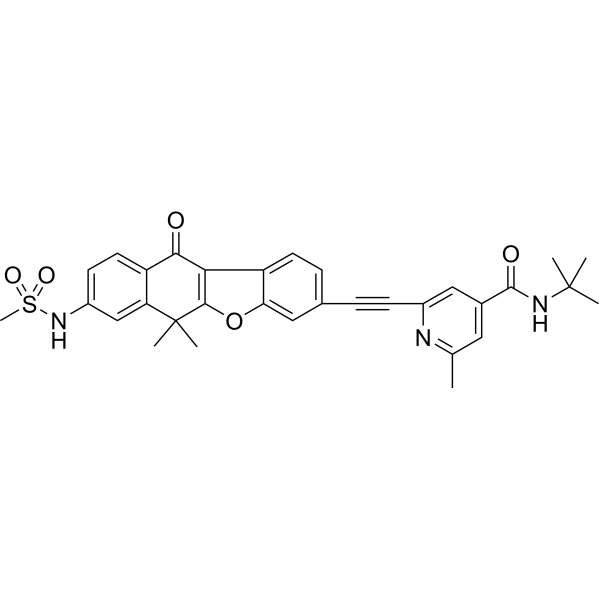
 0 ImagesCat. No.: HY-174330ATRK-IN-31 hydrochloride is an orally active TRK inhibitor with an IC50 of 1.8 nM. TRK-IN-31 hydrochloride has superior antiproliferative activity in the Ba/F3-MPRIP-TRKAG667C cells, and potently inhibits TRK kinase activity with high selectivity. TRK-IN-31 hydrochloride significantly inhibits tumor growth in Ba/F3-MPRIP-TRKAG667C subcutaneous tumor mice model.
-
TRK-IN-31
 0 ImagesCat. No.: HY-174330TRK-IN-31 is an orally active TRK inhibitor with an IC50 of 1.8 nM. TRK-IN-31 has superior antiproliferative activity in the Ba/F3-MPRIP-TRKAG667C cells, and potently inhibits TRK kinase activity with high selectivity. TRK-IN-31 significantly inhibits tumor growth in Ba/F3-MPRIP-TRKAG667C subcutaneous tumor mice model.




